A Cosmic Hammer?
"The experience is real to her. I can’t say there are aliens abducting humans. But I have no way to account for what she is experiencing or thinks she is experiencing."

I sat at the foot of the bed and listened. We were in an artist’s loft in Manhattan and the woman lying there was crying, shivering in great fear. She was being hypnotically regressed by Budd Hopkins, a man who had become involved in a cultural phenomenon referred to as UFO abductions.
“Oh, I don’t want them to do this,” the woman, diminutive and shivering, was almost shrieking. “They’re taking my baby. What are they going to do with it? Oh, please, stop, it hurts.”
Hopkins, an artist who was not trained in psychiatry, urged her to remember she was in a state of recall and what she was experiencing was not real.
“Tell me if you want to stop,” he said. “You can come back any time, but you wanted to understand your lost pregnancy. Let’s allow this to go a bit further.”
I was producing a series of reports on the UFO phenomenon, trying to apply unbiased scrutiny to an overworked subject. Hopkins, who had written a successful book on abductions in Indiana, sensed my constrained skepticism and suggested I speak with a Harvard psychiatrist who was seriously researching claims of abductions of humans by aliens, Non-Human Intelligences (NHIs).
John Mack, PhD, was vilified by the academic and intellectual communities of Harvard, but he persisted with his study of and meeting people who claimed to have absurd experiences. Mack had founded Harvard’s school of psychiatry and had won a Pulitzer for his book about T.E. “Lawrence” of Arabia. We recorded one of his patients who was hypnotically regressing, and the woman’s reactions to what she was remembering under his guidance were disturbing, even as an observer.
“Do you think she was actually taken aboard a UFO and probed with needles by these little gray creatures she described?” I asked him during a subsequent interview.
“I don’t know,” he said. “The experience is real to her. I can’t say there are aliens abducting humans. But I have no way to account for what she is experiencing or thinks she is experiencing.”
Mack’s work under the imprimatur of Harvard University only deepened the mystery of UFOs, now referred to with a more technical acronym of UAP, unidentified aerial phenomena. His research, often dismissed as anecdotal, came to the broader public in the form of a bestselling book that seemed to prove nothing to skeptics. They are having a much more difficult time, however, dismissing what happened in the Colombian town of Buga in March of this year.
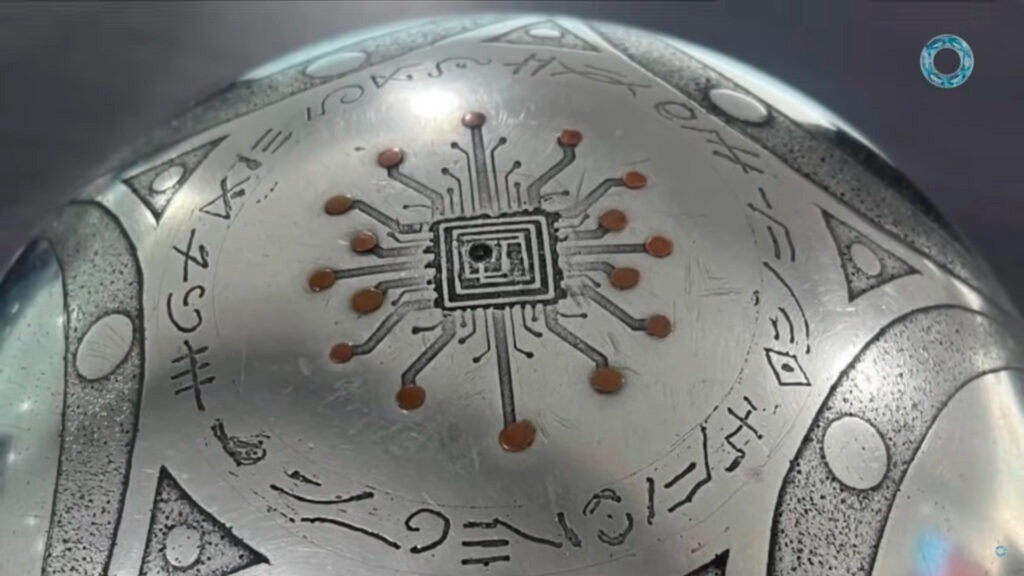
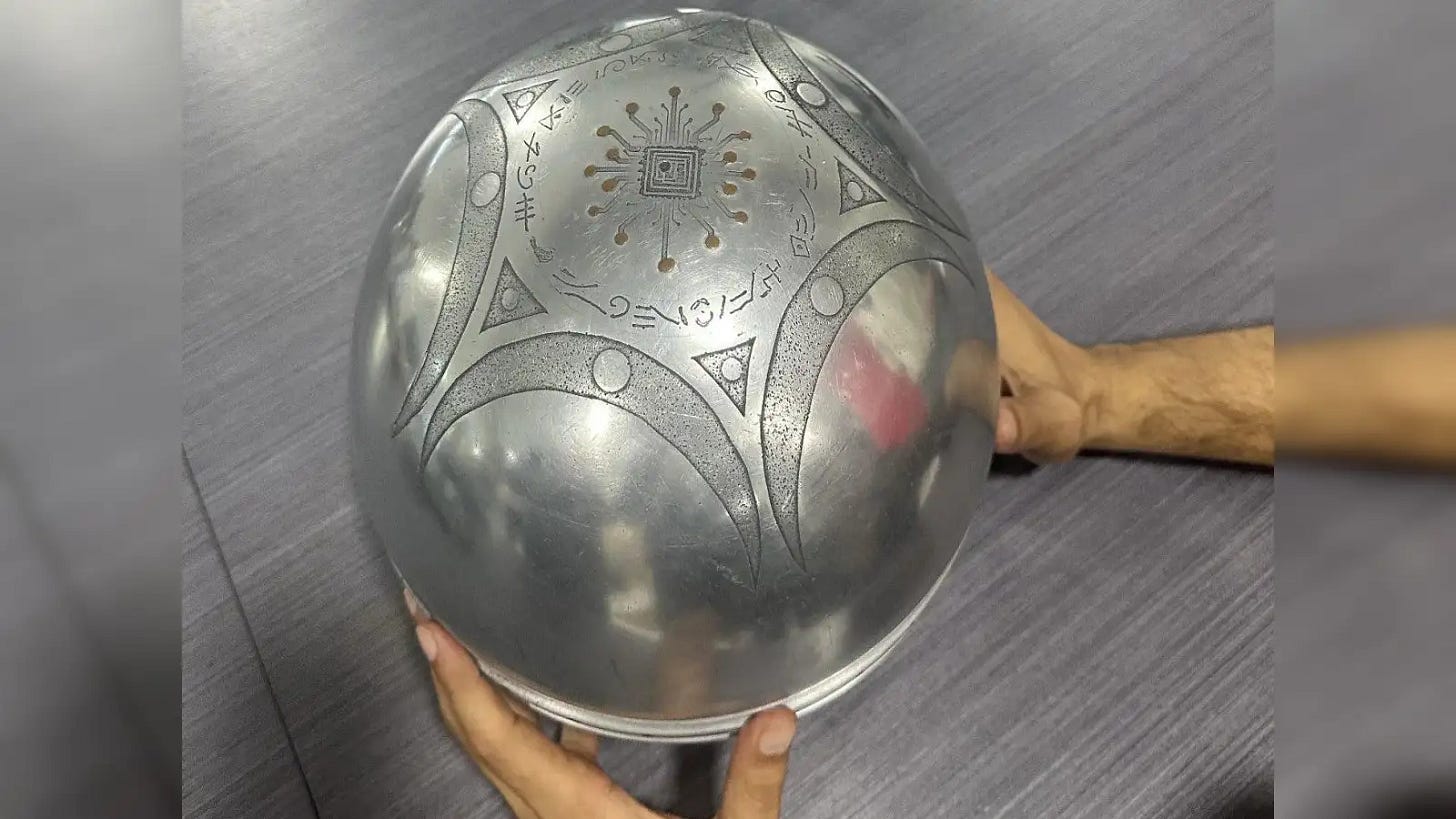
A metallic sphere, cool to the touch like an object fresh from a refrigerator, was recovered by locals after eyewitnesses reported it executing impossible, zigzagging maneuvers in the sky, before losing altitude and landing. Immediately dubbed the Buga Sphere, the artifact weighed approximately 4.5 pounds. Inexplicably, however, it increased in mass over time and its weight more than doubled, and its mere existence began to spread a few cracks into the foundations of human certainty.
Researchers at Mexico’s National Autonomous University (UNAM) got access to the object, and their research revealed a baffling internal architecture of complex, fiber-optic-like wiring, a central “nucleus” surrounded by microspheres, and a complete lack of visible seams or joints. A perfect, seamless sphere of metal is considered a feat beyond current terrestrial manufacturing capabilities. There was also a confounding anomaly of its environmental footprint. The location of recovery was found with a perfectly circular patch of scorched, die-off grass and soil where the sphere had landed, though there was no detectable radiation or chemical residue. Engineer Rodolfo Garrido, who examined the site, described a “strong, decaying ionized field” as the possible culprit, hinting at an unknown physics at work.
Not everyone, of course, remains baffled, even though the sphere exhibited a “negative mass effect,” reducing its inertia by over 80 percent. Nonetheless, where one cohort of researchers saw the signature of Non-Human Intelligence, another saw the hallmarks of a sophisticated human deception. Cognitive neuroscientist and UAP researcher Dr. Julia Mossbridge, a skeptic of extraterrestrial origins for many UAPs, indicated that she thought the sphere “seems kind of like an art project,” pointing to the enigmatic surface symbols as a “classic trick in hoax design,” a mash-up of cuneiform, runes, and circuit board aesthetics designed to provoke intense, global speculation.
If the sphere is an art project, or fraudulent, it’s a very good scam. Should it be confirmed as technologically beyond human capabilities, the world would face an existential tsunami of unprecedented scope with probable catastrophic impacts and even a redefinition of our own species. The first material shockwave would ripple through the global economy. Widespread reverse-engineering of technology from discovered craft could suggest a technology that exhibits a mastery over gravity manipulation and access to limitless, clean energy. The resulting collapse of the multi-trillion-dollar fossil fuel industry would be instantaneous and traumatic. Economies built on oil as an engine, from sovereign petro-states to major energy corporations, would be summarily wiped away. This would not be a gradual market transition; it would be an overnight obliteration of wealth and power, a sudden, forced pivot into a post-scarcity energy future for which our current economic structures are entirely unprepared. The trauma of that shift, the loss of geopolitical leverage and capital, would likely trigger global instability far more profound than any mere recession.
The implications for human authority, too, are terrifyingly profound. What becomes of governance when beings with superior power and intelligence are demonstrably operating within our world? The political theorist Dr. Peter Skafish, co-founder of the Sol Foundation, points out that classified accounts describe not just advanced craft, but also the existence of biological Non-Human Entities (NHEs). This fact, if that’s what it is, might be, according to Skafish, the “single most sensitive data point that is deliberately being withheld from the public due to its world-altering implications.” The government’s claim to ultimate sovereign power, its monopoly on legitimate force, would crumble beneath the shadow of a higher authority. National boundaries and human conflicts would seem absurdly parochial, even farcical, in the face of a shared cosmic context.
Then there is the great question of faith. The world’s dominant religions, Christianity, Islam, and others, offer comprehensive, anthropocentric narratives of creation, purpose, and salvation. What happens to dogma when it is forced to confront a reality not imagined in religious doctrine? The existence of non-human rational beings might be compatible with Christian theology given the historical analogue of medieval debates over humans on the other side of the globe. Nobody knew then if they existed. However, for those whose “core commitment to Christianity is about the exclusivity of Jesus’ action,” the discovery of NHI could be “very threatening to their faith.”
The cynic’s view is that contact would be the death knell for earthly religions, particularly the more anthropocentric ones. Religions are, however, also how humans make meaning, and history shows a remarkable ability for retrofitting and weaving the new, even the cosmic, into the sacred texts. To save a belief system, new arrivals might be interpreted as a form of divinity. The resulting schisms and the formation of new cults, however, would represent a major societal destabilization, a crisis of collective meaning that police forces and governments likely cannot comprehend.
Governments withholding the truth about NHIs and UAPs aren’t just trying to maintain power and economies, though. All humanity would experience what sociologists have described as “past shock.” Histories would need to be reinterpreted and rewritten and religions would lose much of the premises upon which they were founded. The discussion over NHI and UAPs, in fact, has decisively shifted from the realm of fringe enthusiasm to a global policy crisis. When the U.S. Department of Defense began to seriously investigate the phenomenon, scientific stigma was reduced and a more open consideration and research began to be undertaken. The Pentagon may have denied any verifiable evidence of extraterrestrial activity, but the drumbeat of “whistleblower” claims and the high-level attention from legislative bodies, including open Congressional hearings, have validated the external reality of the phenomenon. Legitimate witnesses and even scientists believe something is operating in our skies that defies conventional explanation.
Carl Sagan once famously said that the critical inquiry should not be, ‘Do you believe in UFOs?’ but rather, ‘How good is the evidence that UFOs are alien spaceships?’ The Buga Sphere, whether an authentic artifact of a vastly old and powerful civilization, or an elegant piece of modern performance art designed to expose humanity’s cognitive dissonance, has already fulfilled a purpose. The world has engaged with the question of NHI and the latest global conversations are no longer focused on if something is happening, but on how to prepare for a “catastrophic disclosure.” There are AI simulations that suggest disclosure could occur accidentally within the next two decades. Certain researchers believe we are on the verge of overt contact with off-planet intelligences. Regardless, there seems to be no denying that humanity is slowly awakening to the possibility of its own existential loneliness ending. We might be facing the monumental, and perhaps terrifying, truth that the future of our species could depend on how we choose to treat our new, cosmic neighbors.
Let’s hope it’s better than we’ve treated each other.