America's Second Civil War
"There was no single declaration of war. Instead, hostilities began with a series of knocks on doors that grew increasingly violent through the winter of 2025. By early 2026, Americans were no longer watching history unfold — they were standing in its doorway."

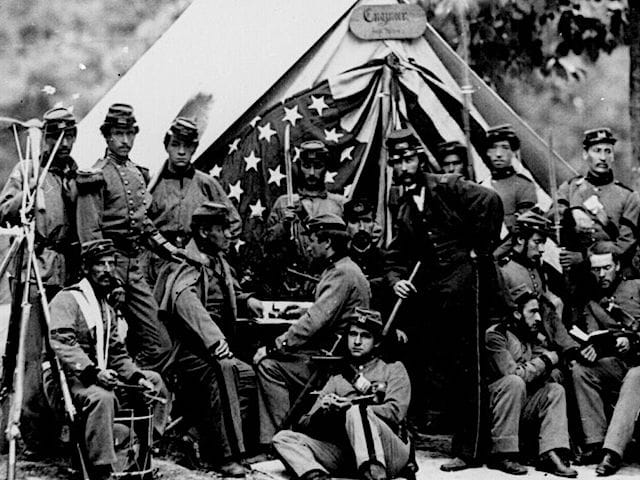
(The story below is speculative fiction that I wrote while sitting around worrying about my country and its future. It is also the stuff of nightmares that an increasing number of U.S. citizens are living with. These scenarios haunt too many of us and millions have begun to see it as a possibly reality. Just acknowledgement of such a horror is stupefying and a metric to show how badly our politics and elected officials have failed to hold the republic together. - JM)

There was no single declaration of war. Instead, hostilities began with a series of knocks on doors that grew increasingly violent through the winter of 2025. By early 2026, the public’s patience with U.S. Immigration and Customs Enforcement (ICE) had reached a breaking point. The agency, bolstered by thousands of new recruits and a massive infusion of federal funds, had moved beyond the border, operating in deep-blue urban centers with an aggression that many likened to an occupying army. Evidence accumulated by investigative reporters and a few vigilant members of congress also showed the newly-recruited officers of ICE were dramatically lacking in meaningful training and were made to pass Trump loyalty tests during hiring interviews.
The the widespread outbreak of combat was directly connected to what came to be known as the “Minneapolis Incident” in January 2026. A botched pre-dawn raid on a multi-family apartment complex led to the death of Renee Nicole Good, a local resident with no connection to the enforcement action. She was simply an observer- bystander trying to get out of the way when she was shot three times and killed by an ICE agent. When video surfaced also showing masked agents using flash-bangs in a hallway filled with children, resulting in permanent injuries to three toddlers and the death of an infant from smoke inhalation, the simmering resentment boiled over. Minnesota became a modern Concord Green, a violent demand for rights that had been abridged by tyranny.
The most significant turning point was the emergence of the “Guardians of the Republic,” a coalition of military veterans who viewed ICE’s unchecked power as a violation of the very Constitution they had sworn to defend. The patriots, children of America’s “Greatest Generation,” were incensed by the idea that their parents had fought across Europe and the Pacific to protect the union only to have those sacrifices tossed into an historical refuse bin by a man who had managed to fraudulently obtain a draft deferment to avoid service in Vietnam. The movement to fight back against ICE began when a retired Army Ranger named Elias Thorne organized the first “Defense Perimeter” around a sanctuary church. Unlike the decentralized protests of the past, these veterans brought discipline and tactical expertise.
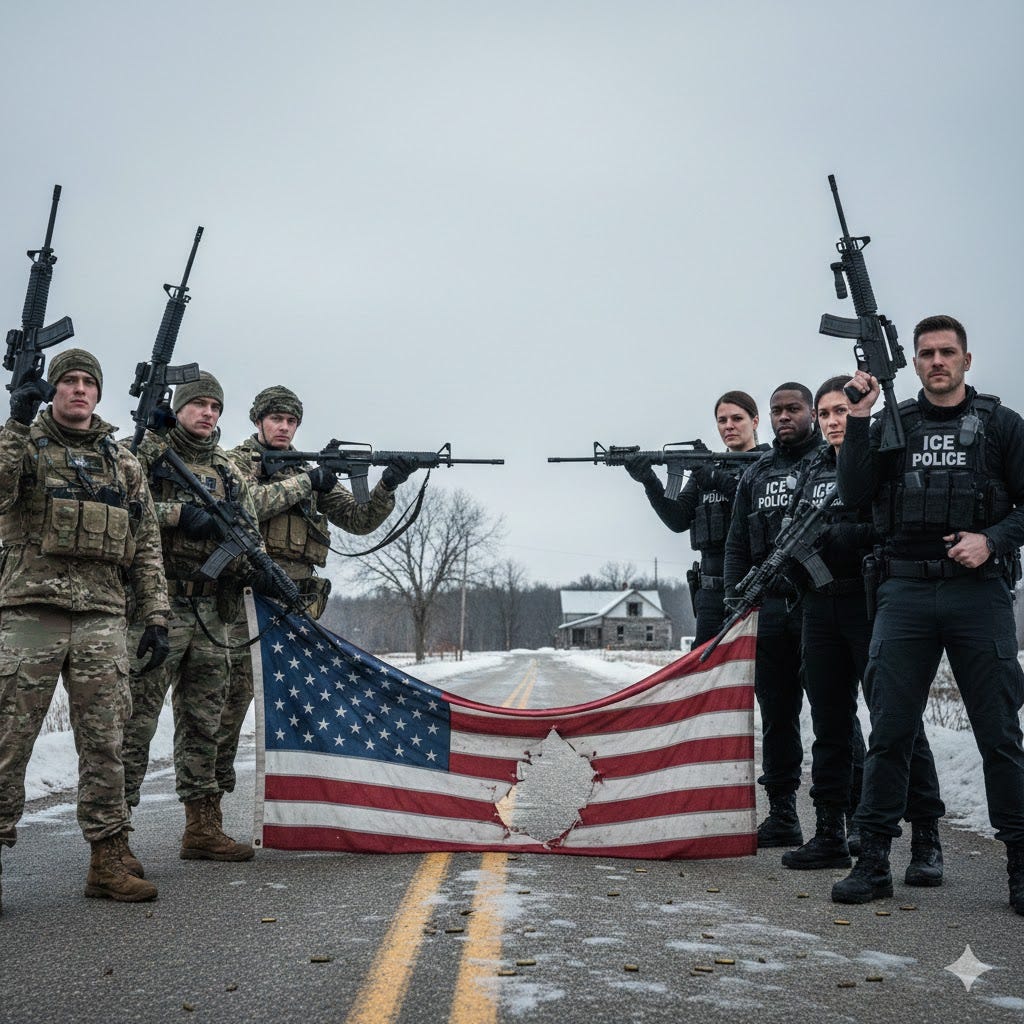
When ICE units arrived, they found a professional skirmish line, not helpless, unarmed civilians. The ensuing firefight claimed lives and shattered the local infrastructure. The death count from Americans shooting Americans that day was estimated at almost one hundred. Stray rounds also ruptured gas lines, causing an explosion that leveled a city block, leaving dozens of civilians buried in the rubble of their own homes. Thorne, shot in the thigh of his left leg, was defiant as he stood in front of TV cameras after the battle had concluded.
“We didn’t fight abroad to see our neighbors disappeared at home,” he said. “And we’d rather keep dying than to live on our knees for a greedy, wannabe dictator.”
The turning point of the Second Civil War was known as the “Battle of the I-5 Corridor.” Battle lines spanned three states, including Washington, Oregon, and California. Resistance units engaged in a coordinated campaign of sabotage against federal supply chains, deploying guerrilla tactics that had been used against the U.S. in Vietnam, a conflict where the world’s mightiest military had been forced to withdraw without victory. Along the I-5 corridor, bridges were demolished to prevent federal troop movements, and the power grid in the Central Valley was crippled to disable ICE detention facilities. In the darkness, platoons from the Guardians of the Republic blew up fences and freed imprisoned immigrants and citizens.
Casualties from the Battle of the I-5 Corridor were staggering. In the crossfire of urban warfare, “smart” munitions failed, striking hospitals and schools. In Seattle, a federal drone strike intended for a militia headquarters hit a crowded transit hub during rush hour, killing 140 civilians. The images of charred commuter buses became the defining iconography of the conflict. No one seemed to be winning; everyone seemed to by dying. President Trump reacted with predictable fury, viewing the resistance as an “insurrection.” He formally invoked the Insurrection Act, deploying active-duty U.S. Army troops to major cities. Tanks rolled down American Main Streets with greater speed and fury than had been demonstrated as they moved through Europe in World War II.
The administration’s decision to bypass the Posse Comitatus Act and suspend habeas corpus effectively ended the Constitution as it had been historically understood. When the Supreme Court attempted to intervene, the President simply ignored the rulings, citing “military necessity.” This unilateralism led to a total collapse of federal legitimacy. The judges, who had been hiding behind black robes, finally saw what their previous legally unfounded rulings had done to the republic.
The Second Civil War did not end in a military victory but in a systemic collapse, and there was no genteel Appomattox treaty signing. As the economy cratered and the military began to fracture along ideological lines, with whole battalions refusing orders to fire on civilians, the Republican-led Senate, fearing total national annihilation, joined with the House to initiate impeachment. The trial in Washington was a mere formality in a city surrounded by rival militias. Trump was removed from office, but the legal proceedings that followed were unprecedented. Charged with high treason and crimes against humanity, he was tried by a special military-civilian tribunal. While many demanded the gallows, the tribunal, seeking to avoid making him a permanent martyr for his remaining base, sentenced him to life imprisonment in a high-security facility, the very type of detention his administration had expanded and had run almost as concentration camps.
The Constitution, however, survived, but in a modified, “Hard-Reset” form. The presidency was stripped of many of its unilateral emergency powers to ensure no single individual could ever again weaponize the federal apparatus against the states. The rebuilding process became a grueling, generational task, which assembled a patchwork of “Reconstruction Districts.” The healing was not just physical. The bridges of the I-5 and the leveled blocks of Minneapolis took years to rebuild. The psychological wound, though, to a country once unified by a founding document, was compounded by learning to live with the wounds of a war where the front line had also been the front porch.
The American experiment did manage to continue, not as a triumphalist empire, but as a humbled, more localized union, proving that while a nation broken by power can, ultimately, only be mended by the slow, quiet work of justice. The America that confronts the 2030s is a more humble and localized patchwork of people and their dreams. The “Imperial Presidency,” always a construct doomed to fail, is dead, and replaced by a more collaborative federalism. The scars, however, remain visible. There are still “Red” and “Blue” zones where the cultural divide is managed through cold tolerance rather than warm unity.
The healing process is slow because it requires the American public to confront the hard truth that the institutions they trusted to protect them were easily turned to the opposite task. When the war ended, the United States transitioned from a nation of “top-down” authority to a “bottom-up” democracy. The peace, though fragile, is one held together not by the threat of federal force, but by the hard-won realization that the Constitution is more than just a piece of paper. It makes aspirational demands that all American citizens live and work together as equals, and that we are standing on sacred soil, not as enemies of the state, but as one unified force against tyranny in all its forms.