My so-called Cancer Journey
When you walk into a cancer hospital and see the terrible suffering and extreme treatment that many patients have gone through (and are going through), some for years, especially children, then it puts the brakes on the self-pity party.

“Ok, we have work to do. Your biopsy shows some aggressive cancer in your prostate.” This was the urologist who had seen my abnormally high PSA blood test and remarked only a few days before that I shouldn’t worry, that other indicators (?) weren’t all that worrisome. Then the biopsy results came back. So much for not worrying.
All I had wanted was to try one of the GLP-1 drugs. I’ve been an overweight little troll for much of my adult life, and it was weight I could not seem to control. “Well, Chris, did you try an intense program of diet and exercise?”
Next question, please.
As health problems piled up, and blue jeans rivets continued to pop off, the literature on Ozempic, Wegovy, and other similar drugs seemed to indicate that they were safe and effective. Even better, they were often described as “miracle drugs” for the added benefits of reducing heart disease, the incidence of stroke, and lowering blood pressure, among others.
The hurdles were many, as the drugs were still enormously expensive without insurance coverage (which was mostly denied). They are very much prescription controlled (I didn’t have a GP, and haven’t, well… forever.) They also come with a small bucket of potential side effects (mainly stomach and gut issues).
But again, I was tired of being such a lard-ass.
When I found a good GP, he was really good, in that he insisted on doing a full 100,000 mile checkup. Even after the first blood tests came back and a PSA test was inadvertently left off, he insisted that I return to get one. (PSA is a simple blood draw that measures a protein made by the prostate gland, a fairly reliable indicator of prostate health.)
And… boom, the “C” word. (Also high blood pressure, high blood sugar, blah blah blah. Damn doctors. They always find something. Or cancer.)
A referral to the urologist followed, and then that biopsy. Sidenote; biopsy was the worst single event of the process. I won’t go too deep into this, though the urologist sure did. It involved a rather large sex-toy looking object being shoved exactly where you think it would get shoved, as biopsy needles took samples of the prostate gland. As I like to refer to it, “the prison rape scene.”
But I digest.
It goes without saying that hearing someone give you the “C” news is unnerving to say the least. Like other traumatic events in life, you don’t envision it happening to you. Like other chronic illnesses, it is hard to be certain of the severity of the disease, the effectiveness of a given treatment, and the long-term prognosis. Even with the best doctors (and I have the best), your conversations with them will be filled with probabilities for complete cures, for temporary remission, for side effects…
“If I go through your suggested treatment, will that cure it?”
“Oh, you know, sure. OK, probably.”
“What, “probably”?
“Let’s see, with this type of this cancer, at your age, with your co-morbidities, looking at these scans, I’d say you have a 28.6-78.5% chance of most likely living 3-30 years. Probably.”
I exaggerate.
Probably.
The fear, anxiety, and apprehension about the diagnosis is nothing compared to worry about how it will be paid for. Luckily, we are at a place and time in our life when my wife’s company’s insurance has covered us about as well as any private insurance ever would. And it was luck. We have struggled and fought with several insurance sources over time — COBRA, the ACA, the good and terrible of private insurers, and even skipped a month or so as there were job/career changes, hoping/praying that a few weeks could go by without catastrophe.
As far as care, I got referrals and was accepted by one of the finest cancer hospitals in the nation, MD Anderson.
And let me be clear, in Houston, there are many really fine cancer specialists and clinics. In doing my research, a couple of friends of mine had treatment here in town with other institutions, and both had great outcomes. One doc (tooting his own horn, no doubt) suggested that my outcome would be 10%+ better just being around this great medical center. I met several patients from out of state who confirmed that. They were dissatisfied with their treatment at home, and came here.
As personal as this story is, I’d also say it’s a story for anyone with a chronic illness, debilitating disease, or crippling injury. Everyone deserves top-notch care. There is no excuse, as they say, for the richest (formerly richest?) country in the world not to provide free or deeply subsidized healthcare AND medication.
Before they settled on a detailed treatment plan, MDA started me on two different anti-androgens. What is an ‘anti-androgen,’ you might ask? I did.
“What is an ‘anti-androgen’?
“Basically, a testosterone blocker.”
“A testosterone blocker? What does that do?”
“Prevents your body from making and using testosterone. You know, chemical castration.”
“I’m sorry, I thought you said something about ‘castration.’”
“Yeah, chemical castration. Prostate cancer feeds on testosterone.”
“Well, I may be getting old, and my trollish squatty physique may belie it, but I’m still a red-hot blooded, virile specimen of a man!”
“We took care of that about an hour ago with the injection you received. So, take up quilting, watch the Hallmark Channel for a year or two.”
“But…”
“Or we can let the cancer spread... <pause for effect> Well?”
“Gimme a minute. I’m thinking…”
The doc suggested that the insurance company might fight over at least one of the drugs, but they would help. (They approved them.) The retail price? $180,000 a year, and they wanted me on it for two years. I poked around. It’s available in Japan for $20,000. Sick. Insane.
RANT #1
Rather than subsidize medical care and all of the science and education behind it, this administration has gone the opposite direction, naturally. Trump and his courtiers, who only need to pledge loyalty to the king and bring him their own ragtag little mob of dingbats and anti-science conspirators, have slashed funding for all the sciences. Medical research seems to have been hit particularly hard. Infectious disease tracking, cancer studies, and clinical trials have been eliminated or badly disrupted. Hundreds of canceled clinical trials left patients and their docs in the lurch. Hundreds of grants related to infectious diseases, vaccine research, and public health tracking have been frozen or were simply eliminated.
In Houston alone,
Rice University's NSF funding fell from $14.1 million to $4.2 million comparing the first nine months of fiscal 2025 to fiscal 2026; the University of Houston dropped from $7.6 million to $2.8 million; Texas A&M tumbled from $11.7 million to $2.4 million. MD Anderson Cancer Center absorbed a 26% cut in NIH funding, landing at $73 million this fiscal year, while Baylor College of Medicine fell from $147 million to $125 million. The slowdown traces to a two-month government shutdown and the Trump administration's ongoing overhaul of how grant applications are evaluated.
This all orchestrated by conspiracy theorist and the Kennedy family black sheep RFK, Jr., who, unencumbered by any medical training whatsoever, is one to enjoy a lovely piece of roadkill for dinner with a side of measles and an extra helping of chemtrails. In the 2024 presidential election, he and his ego ran and failed as a Democrat and then as an independent, until he finally endorsed Trump, in exchange for his appointment as Sec. of Health and Human Services. He found his greatest fame in vaccine denial, a position he promised at his Senate committee hearing that he would reverse as soon as his appointment was approved. Like all Trump minions, he reversed and doubled down instead.
Our medical leadership in Trump’s America, ladies and gentlemen. Don’t get me started on Elon’s little DOGE flying monkeys and the effect that they had on medical research and the lasting damage that they did. Or the appropriately named Dr. Oz and his quackery at Medicare & Medicaid Services (CMS).
Don’t worry kiddies, there’s plenty of ivermectin for sale, now available over-the-counter.
At MD Anderson, I was able to talk to a surgeon and a radiologist about the best option for treatment. It was decided that I was a better candidate for radiation: about 6 weeks' worth of daily treatments (weekends off). It took several exams, scans, and MRIs to prep for this. It takes a lot of poking, prodding, imaging, and generally giving up on whatever dignity you thought you had. The last step was to get three or four small gold beads inserted into the prostate itself, along with a couple of tiny marker tattoos near my waist and groin area. These all together would serve as registration marks for the radiation beam to line up with during treatments. Luckily, this procedure was done under anesthetic.
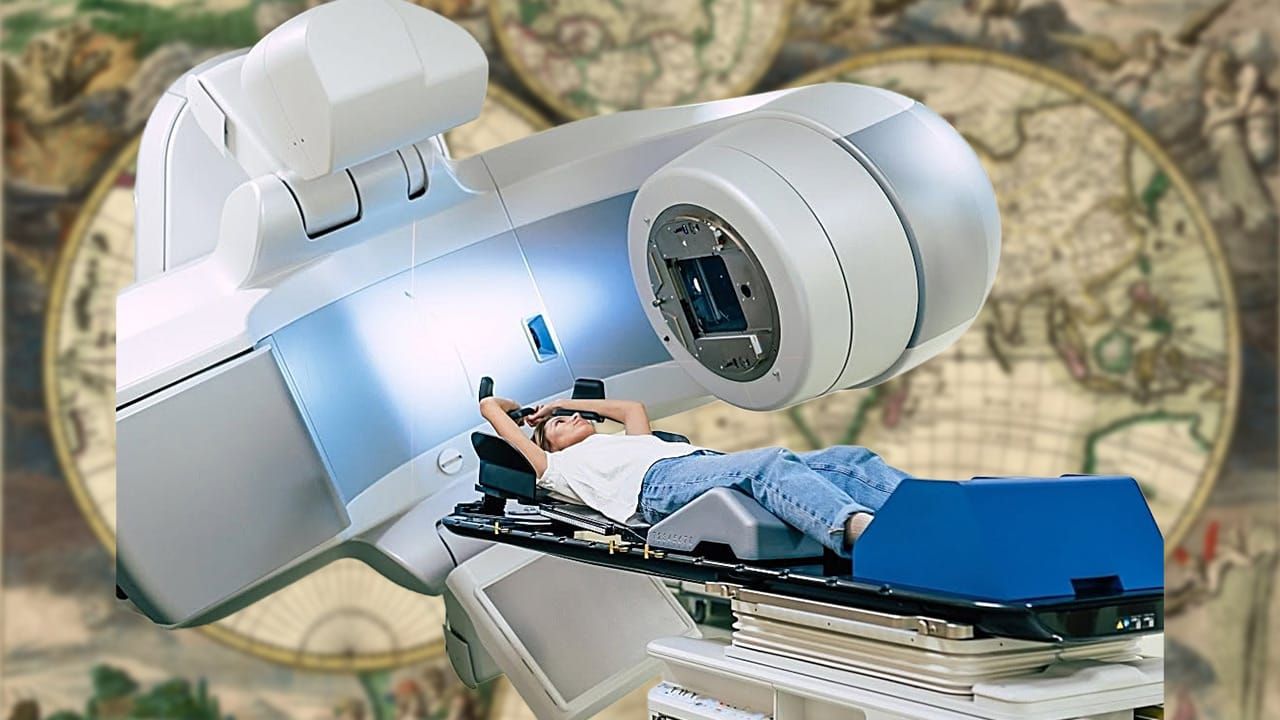
The drug side effects were starting to take a small toll. Fatigue, “brain fog”, back (muscle) aches, and of course, ED and the whole castration thing. I was also warned that I would have serious ‘hot flashes,’ but for me, they never materialized. A week after the markers (“fiducials”) were implanted and then mapped, I had my first treatment. These were, in all honesty, fairly low-impact procedures… at least the actual delivery of radiation. Hop up on the table, show enough skin to reveal the tattoos for the techs to line up the registration lasers and center me on the table, ask me what kind of music I want to listen to (really), and then they would leave the room. Shutting a massive foot-thick door behind them. Hmmmm. The massive radiation generator, or linear accelerator, would begin 360° circles around me. You could hear it clicking pictures to check the beam alignment, and then buzzing as it continued its orbit, presumably zapping cancer cells away. Then it stops. If all goes well, maybe ten or 15 minutes pass, tops. The techs help you off the table, you tuck in your shirt, put on your shoes, and you’re free to leave.
Like the drugs, the side effects after the first week of treatments were mild to undetectable. And like the drugs, I thought that I would be some kind of exception, and escape dealing with any harsh side effects. (You know where this is going…) And like the drugs, as the treatments added up, so did the misery of those side effects. And since many of the effects were somewhat similar, they just reinforced each other. The fatigue, the lightheadedness, some aches, and add on some nasty digestive problems. (Cramps, etc.)
The body was fighting off attacks on internal tissue, even if some of it was cancerous.
 Karen Hoffman, M.D.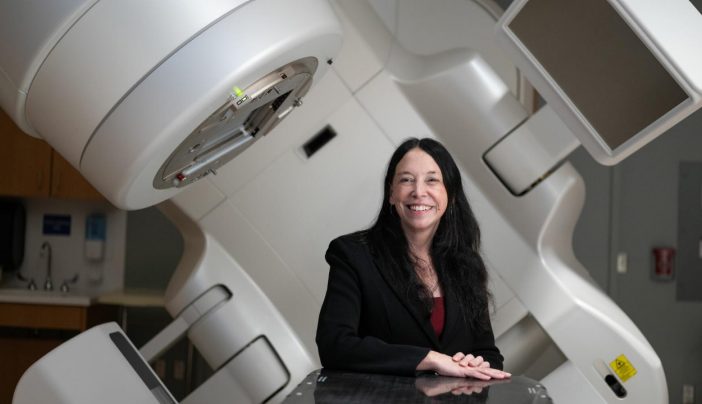
One of my docs, radiation oncologist, Karen Hoffman, M.D. sitting under the linear accelerator
Gonna be honest here: for my diagnosis and months of (still ongoing drug) treatment: I was never hospitalized, the cancer itself has not created painful symptoms, and my physicians are hopeful that my outcome will be good. And I appreciate that it’s a tired trope to say “it could have been worse” (and it ain’t over yet). But when you walk into a cancer hospital and see the terrible suffering and extreme treatments that many patients have gone (and are going) through, some for years, especially children, then it puts the brakes on the self-pity party. You meet folks who have traveled across the country, and some from other parts of the world to get here; for many, it is their last hope. There are the chemotherapy patients that are too sick to take care of themselves. Scarves wrapped around bald heads on women and even small children. And finally, folks with such advanced cancer that you wonder if hospice isn’t the next step on their journey.
RANT #2
Which brings me to another rant. I hate, hate, HATE that word. Yes, the “C” word sets me on edge. But if I hear “journey” used in the context of me (or anyone for that matter) dealing with cancer, I swear I might just have one of my little episodes. Maybe it’s the absolute overuse of the term in ANY context that I despise. (“How’s your cancer journey?” “Tell me about your maternity journey…” “Your Monday journey sounds interesting!” “It was one of the hardest parts of my acne journey.”
A journey should include a cyclops, a siren, some lotus-eaters, and a stopover in the land of the dead. Or maybe a trip on a rickety balsa raft weaving around the Pacific in an attempt to recreate the voyage of the Kon-Tiki. At the very least, a journey should be an excursion around the moon as part of the Artemis program.
And simmer down if you have your finger on speed-dial to call the language police out on me. “Journey” can be a metaphor as well as a physical excursion. I get it. But spare me your discussion of freeway traffic to get to work as part of your “career journey.” When you hear the word a dozen times in one day, it loses all meaning. “She was on a journey to find herself.” Take a right at the light and a left at Albuquerque.
Cancer (and other debilitating/chronic illnesses, conditions) are painful, scary slogs. A slog physically and mentally. A day-to-day existence that at any given moment might reveal a bit of healing, or the tragedy of lost hope. You’ve known someone with cancer, or advanced pulmonary disease, maybe late stage Alzheimers. The never-ending trips to the clinic or even the emergency room. The insurance company or Medicare fights. The uncertainty of mortality. The pain meds that never seem to cut through quite enough, leaving you to watch a loved one breathe pain in and out.
Journey? That’s a sales term, a bit of marketing applied to a terrible situation. A morning talk-show word to soften reality. You’ve never held the hand of a person in the ER hoping for just a few more cc’s of morphine in the drip and said, “Hey, how's your journey!?”
This is me, OK? My humble and sometimes contrarian opinion. If it’s language manipulation that gets you or a loved one through the day, that’s fine with me. It just seems that we’ve made it so that word is a meaningless way to speak of these wretched struggles.
The takeaways from my experience (and everyone’s experience is absolutely unique)
• Like they say. Get a checkup. I was a dumb as they come by not getting a regular screening, And probably made it worse than it needed to be if it had been spotted earlier. Prostate cancer detection is now a simple blood test. If you have weird symptoms of something, see a doc. Ladies, do the mammograms and pap smears. Whatever the suggested protocol is. If you have a family history of this stuff, double down and start earlier than is recommended.
• Fight for a better health care system. I was extraordinarily lucky/blessed/privileged to live in a town that has some of the best medical care facilities and cancer specialists in the world. I was absurdly lucky to have good insurance that could get me that care, though it has still been costly. I could lose that insurance at any moment for any number of reasons. To walk into a premium facility like MD Anderson only highlights the number of folks that can't, and as a result get lousy care elsewhere, or won’t get any kind of specialty care at all. That’s a matter of our country’s completely dysfunctional medical care system.
• Remember that much of this country’s success, wealth, and yes, military strength have been built on science, medicine, and technology, and quality education that advances those sectors. We are living in a time that profiteers, oligarchs, and an entire political party would like to tear much of that down.
Vote. Vote the bastards out, up and down that ballot. From the local school board to the POTUS, we must restore science and regain trust in our educators, doctors, and scientists. It will take more than a midterm election, or throwing out one wretched president, so get busy and get your kids busy. VOTE. Keep voting.
• One more thing. Thank in every way possible, health care workers. Doctors, yes, but especially the nurses, their aides, techs, even receptionists... the ones that we all recognized and loved during the pandemic, then kind of let fall out of our sights. They're still there, still mostly underpaid, certainly overworked, and are dealing daily with dozens of people in terrible pain. Most are the ones that you will be counting on to explain in detail what is happening, hold your desperate hand, and allay your fears. In general, they are a kind and compassionate bunch. And daily they face some pretty challenging work and more than a few challenging patients.
Like all cancer patients, I await the next checkup. The next blood test. The next scan. It is a wait filled with apprehension. Is evidence of cancer gone? Is it in remission? What are the odds it will come back? What are the chances it was all for naught? Can I stop taking all these drugs and get away from these side effects? It’s hard to know for sure.
The journey continues. Ugh. "What a long strange trip it's been."
Author's Note: If you wish to use the word "journey" in speaking of a medical struggle, go ahead. You don't need one more negative idiot giving you advice. This is me, being me. But voting out the people that are destroying an already unstable health care/insurance system? Yeah, I offer no equivocation on that one. Get rid of these MAGA/GOP bastards.